
A home usually looks outdated because of a handful of time-stamped design elements rather than the age of the building itself. It is rarely one thing that gives it away. Honey oak cabinetry, vertical blinds, cool grey laminate flooring, shiny brass fixtures, matching multi-piece furniture sets and builder-grade light fittings all point straight to the decade they were chosen in.
The good news is that spotting them is the hard part.
Once you know what to look for, most outdated design elements can be updated without a renovation, and often without spending much at all.
Lighting That Ages a Space Instantly
Lighting is the cheapest high-impact change in most homes, which is why it is worth looking at first. Ask a principal designer where to start in a tired room, and lighting comes up before paint does.
Flush-mount ceiling fixtures, the domed ones often nicknamed boob lights, are one of the clearest signs a room has not been touched in years. Old ceiling fans and generic builder-grade globes do the same job. They are the textbook example of a fitting nobody actually chose; it simply came with the house.
Shiny brass and glossy gold fittings quickly date a space, as does relying on a single overhead light. One harsh source from the ceiling makes a room feel flat and uninviting, no matter how good the furniture underneath it is.
The modern approach is layered lighting: a ceiling fixture supported by lamps and wall lights, in softer metals such as polished nickel or matte black used consistently through the room. Opt for one metal and repeat it rather than mixing three.
Very little else delivers a change this noticeable for the money, which is why lighting features so heavily in current home staging trends.
Matching Furniture Sets Make a Room Feel Predictable
Buying an entire matching bedroom or living room suite is one of the quickest ways to make a room feel outdated. Overly coordinated furniture sets create a predictable appearance, and identical pieces repeated around a space tend to feel uninspired rather than pulled together.
The reason is simple. Matching furniture sets remove depth. Every timber tone, leg shape and fabric is the same, so the eye has nothing to travel across and the room reads as a showroom rather than a home.
Every piece is performing the same note at the same volume.
Mixing textures, timber tones and styles creates a far more modern look. That does not mean anything goes.
A well-chosen furniture package still holds a room together through colour and scale; it simply varies materials and shapes instead of repeating one finish eight times over.
Keep the Pieces That Carry Your Story
Family heirlooms, a well-loved dining table or an inherited hall stand bring character and warmth that new furniture cannot replicate. The trick is pairing them with current pieces so they read as intentional rather than left behind.
They carry your journey with them, and that is a kind of charm no showroom can sell you.
This is where personal style beats trend-chasing. A room built around what you genuinely love ages far more slowly than a room styled entirely on trend, because it was never tied to a particular year in the first place.
If you feel stuck in a room that is technically fine but somehow flat, a lack of personality is usually what is missing.
Window Treatments Give Away the Decade
Plastic vertical blinds, cheap panels, heavy swags and floral valances are some of the most strongly time-stamped items in any home. Heavy fabrics and fringed trim belong to the ’70s and ’80s, and they pull a room backwards even when everything around them is current.
Condition counts as much as style. Dirty or cracked blinds read as neglect, which is the last impression you want when a buyer is walking through. A helpful way to test this: stand in the doorway and ask whether your eye goes to the window itself or straight through to the view outside.
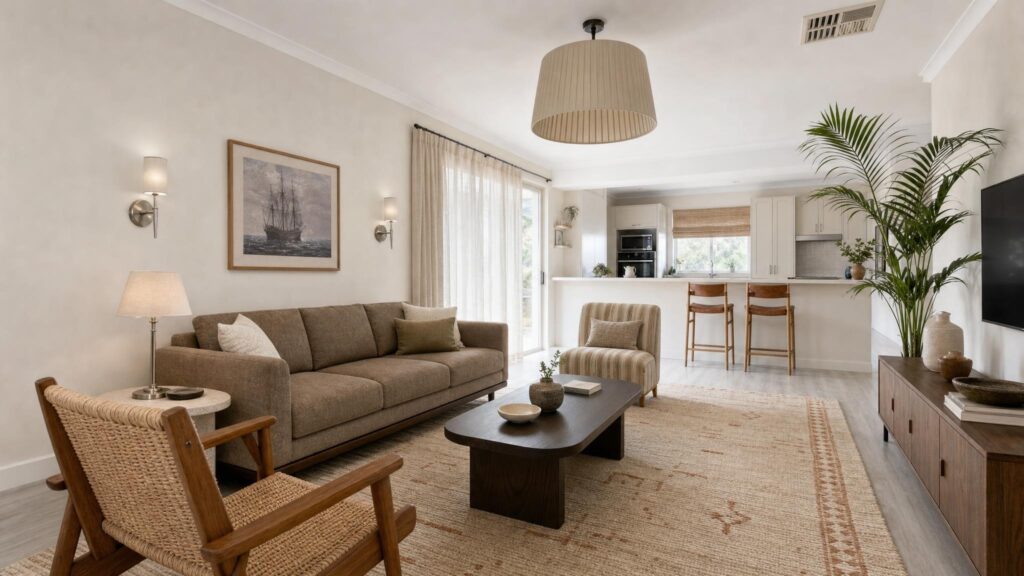
Linen drapery panels and woven shades are the modern alternative. Both soften a room and add texture rather than blocking it, and updated window treatments often do more for a space than new furniture would.
Themed Décor and Clutter
Overly literal themes date quickly. Nautical and country schemes have had their turn, and heavy modern farmhouse, with an excess of shiplap and sliding barn doors, is now heading the same way. Themes date because preferences shift, and a room fully committed to one idea has nowhere to go when they do.
The low-commitment version works much better. Borrow the elements of a style you love through cushions, art and smaller décor rather than through built-in finishes.
Clutter is the other half of this. Too many knick-knacks make a room feel chaotic, and quality over quantity is the rule worth sticking to.
Curate groupings in odd numbers, give each one room to breathe, and the pieces you kept will actually get noticed.
Hardware, Cabinetry and the Small Finishes
Honey oak cabinetry, matching trim and varnished orange-toned banisters are the classic time stamp, and they are often what makes a perfectly functional kitchen feel decades behind.
Small details carry more weight than people expect. Cheap brass hardware from the ’80s, mismatched basic chrome, worn doorknobs and tired handles all detract from a home’s appeal, and all cost very little to replace.
One point worth making: black hardware is now being called a dated trend in some quarters, which is a useful reminder that any finish chosen purely because it is on trend will eventually date.
A finish you actually like, repeated consistently through the kitchen and bathroom, ages far better than one picked off a trend list. New handles and tapware can lift dated cabinetry without touching the cupboards themselves.
Flooring That Quickly Dates a Room
Flooring is one of the first surfaces a visitor registers, and one of the fastest giveaways of a decade. Cool grey wood-look laminate and vinyl plank, everywhere through the 2010s, now reads as distinctly of its moment. Wall-to-wall carpet has the same effect, and cheap vinyl tends to look inexpensive as well as dated.
Orange-toned oak flooring from the 1980s is the other common offender. It is not that the timber is poor quality; it is that the warm orange tone is so strongly tied to one era.
What feels current instead is lighter timber, warm neutral tones and ceramic tiling rather than dark or cool floors.
Flooring is a big-ticket change, so if replacing it is not on the cards, warm rugs and warmer furniture tones will lift a cool floor more than you would expect.
It is the one upgrade worth planning for rather than rushing, and until then, a styling refresh will do more than most people think.
Want More Advice to Revamp Your Home? Contact Furniture Fitouts Today!
Dating a home is rarely about age. It comes down to a handful of choices that anchor a room to the decade they were made in.
The upside is that most of them are fixable. New lighting, softer window treatments, mixed furniture pieces and updated hardware will shift a room forward without a renovation.
If you would rather not work it out alone, our team can help you sort what stays, what goes and what to replace first.
Get in touch with Furniture Fitouts today and let’s bring your home back up to date.